Choosing an STM32 in 2026
Feb 2026
The STM32 suite of microcontrollers (MCUs) is a powerful family of SoCs. They are known for their high performance, low latency, power efficiency, and supporting software tools. Alongside other MCU families such as ESP32, they have been widely adopted by professional and hobbyist communities.
However, for those who are not familiar with the vast STM32 ecosystem, it can be daunting when attempting to choose a variant for a particular project. STM sells hundreds of variations of MCUs, and many of them are shipped on development boards, evaluation boards, expansion boards, and discovery kits. In this post we attempt to differentiate between them so an informed choice can be made.
STM32 Naming Conventions
All MCUs begin with ‘STM32’ to indicate the manufacturer (STMicroelectronics) and their 32-bit architecture. The series designation of an STM32 can reveal a lot about what a particular MCU is capable of. Each series is named for its use-case (X) and the ARM Cortex-M core which it contains (Y) in the format STM32XY.
For example, the STM32H7 is a high-performance (H) MCU with an ARM Cortex-M7 (7) processor core.
| X | Use-case |
|---|---|
| G | Mainstream |
| F | Foundation |
| H | High-performance |
| L | Ultra-low-power |
| U | Ultra-low-power & high-performance |
| WB | Wireless Bluetooth |
| WL | Wireless LoRa |
| C | Compact |
| Y | Core |
|---|---|
| 0 | ARM Cortex-M0 |
| 1 | ARM Cortex-M3 |
| 2 | ARM Cortex-M3 |
| 3 | ARM Cortex-M4 |
| 4 | ARM Cortex-M4 |
| 5 | ARM Cortex-M33 |
| 7 | ARM Cortex-M7 |
Aside
To ease potential confusion, an ARM Cortex-M processor core is the ‘brain’ of the MCU (designed by ARM). An STM32 contains this core and numerous peripherals such as timers, ADCs, communication blocks, memory, DMA, and many others to form a useful standalone IC. STM completely manage the physical manufacturing of the product.
Generally, in a core of the name ARM Cortex-MX, the higher X is, the more performant the core is. The generation of the core will also impact performance.
Full model names typically look like this: STM32F072C8
The remaining letters and numbers indicate sub-family, pin-count, flash size, package type, and temperature range.
Overview of STM32 Families
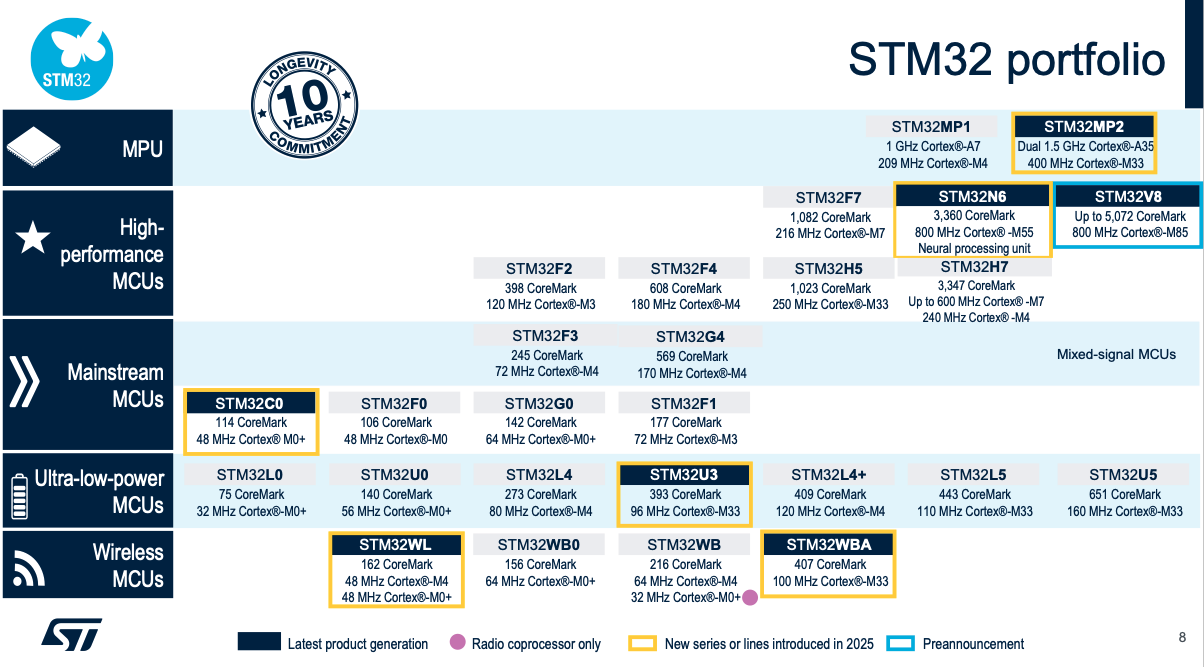
ST divide their products into 5 categories: MPUs, high-performace MCUs, mainstream MCUs, ultra-low-power MCUs, and wireless MCUs.
Mainstream MCUs
The mainstream category features the F0, F1, F3, G0, G4, and C0 series. These chips are good all-rounders, balancing power efficiency with performance and functionality.
Of these, the F3 and G4 are advertised as mixed-signal MCUs. Of course every STM32 has analogue functionality, but these ones are designed with performant ADCs, high-resolution timers, and onboard op-amps. They are intended for use in instrumentation, control, and signal processing systems.
Ultra-low-power MCUs
The L0, U0, L4, U3, L4+, L5, U5 series are known for their low-power draw. These are useful in a context where power is limited. These chips also tend to be very low-cost.
Wireless MCUs
The WL, WB0, WB, WBA series feature built-in wireless communications hardware such as BLE and LoRA modules. Having this functionality on the SoC brings multiple advantages such as power conservation, reduced footprint, and ease of development.
High-performance MCUs
These include the F2, F4, F7, H5, H7, N6, and V8 series. These MCUs are geared towards compute-intensive tasks such as DSP and embedded AI.
Microprocessors (MPUs)
Microprocessors like the STM32MP1 and STM32MP2 are in a class of their own. These MPUs feature ARM Cortex-A cores for higher performance, in addition to Cortex-M cores for real-time tasks. They are capable of running complex operating systems like Linux, compute-heavy AI models, and can drive sophisticated user interfaces.
Unlike MCUs, MPUs require external memory and feature a memory management unit (MMU) for virtual memory.
Form Factors
In addition to standalone ICs, STM sells a variety of development board types so their MCUs can be tested and prototyped with. In this section, we attempt to explain each type.
Pill Boards
Blue Pill and Black Pill boards feature the STM32F0 and STM32F4 MCUs respectively. They are similar in size to the Arduino Nano but far-outperform it on compute.
Nucleo Boards
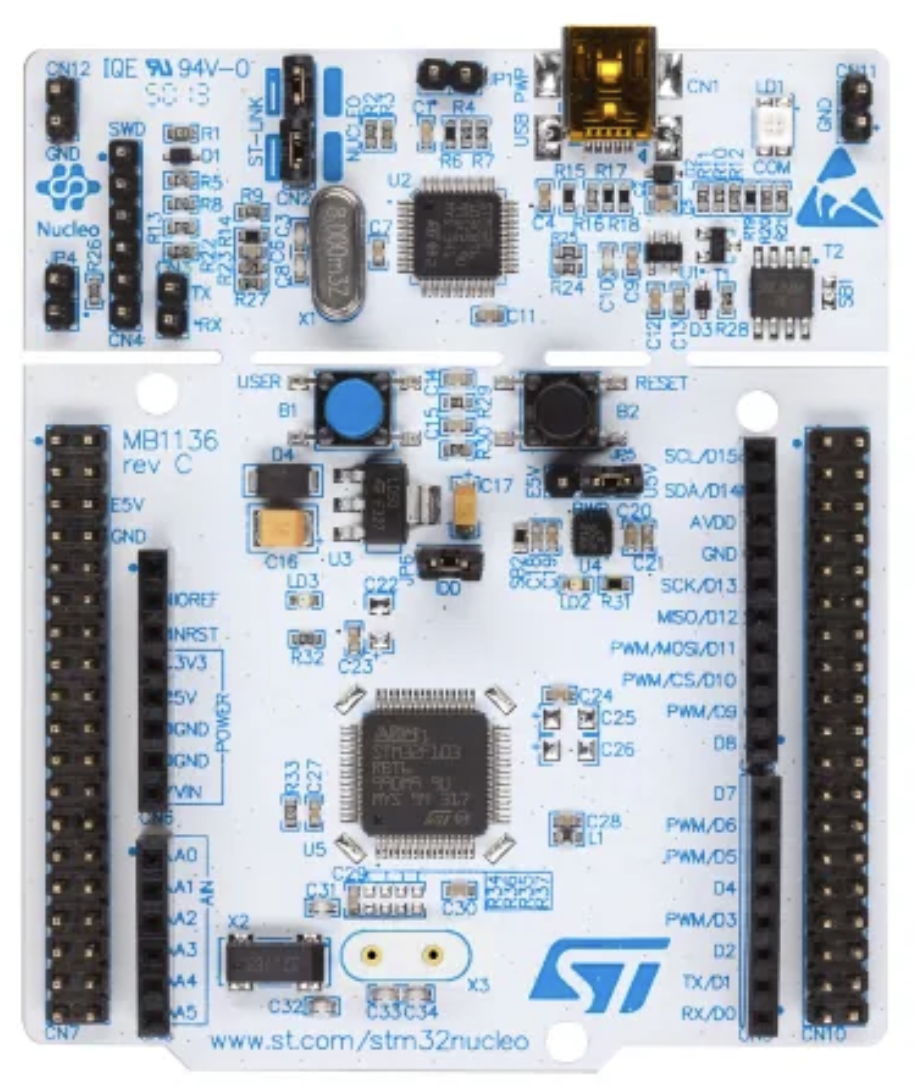
Nucleo boards are the de facto development board for STM32 in 2026. There are 3 main sizes of Nucleo boards: Nucleo-32, Nucleo-64, and Nucleo-144. They roughly correspond to the dimensions of the Arduino Nano, Uno, and Mega boards respectively; some are even physically compatible with Arduino shields.
For any STM32 series (F0, N6, etc.) you can find numerous variants of Nucleo boards. Almost all of them feature a user button, reset button, dozens of pins (with pre-soldered headers), an SMPS, and a few LEDs. An ST-Link debugger/programmer is also included for ease of use and this may be removable for certain boards.
Discovery Kits
Discovery kits build on Nucleo functionality with on-board sensors, LCD screens, and other sensors to demonstrate MCU capabilities. They are used for prototyping.
Evaluation Boards
Evaluation boards are typically used to showcase a sample product. They provide sensors, displays, peripherals, and everything else to showcase the full horsepower and feature set of a particular MCU. They are often more expensive than Nucleo and Discovery boards.
Other Differentiating Factors
These are more factors by which STM32s are differentiated.
Floating Point Units (FPUs)
FPUs enable optimised floating point (non-integer) mathematical computations. FPUs are useful for applications that require precise control, DSP, sensor fusion, ML, and multimedia data handling.
MCUs without an FPU can still do floating point calculations, but with much less speed.
Number of Cores
Some MCUs can be dual-core, such as the STM32H7 (which also features a single-core variant). Dual-core MCUs are more expensive and power intensive, but enable the MCU to execute more than one task at a time; for instance, one core may be running a program related to an interactive GUI whilst the other processes sensor data.
Analogue Peripherals
ADCs and DACs can vary in speed and precision. Availability and specification of various timers may also be a consideration.
Memory
Amount of available flash memory and SRAM may be a factor. Flash is non-volatile memory that stores firmware (compiled embedded code) whilst SRAM holds the stack and heap. On small MCUs, such as STM32C0 series MCUs, this can limit program size, especially if an RTOS is used; however, external flash and SRAM may be used to expand memory if required.
Other Specialised Hardware
Graphics accelerators, display interfaces, communication translators, and neural processing units, amongst other specialised hardware are featured on specific MCUs. These factors and others should be considered on an application-specific basis.
Conclusion
There are hundreds of STM32 MCUs to choose from. They vary in form factor, compute capability, power draw, and peripherals. The STM website features a tool that can be used to narrow down options, as do major distributors (Digikey, Mouser). Remember, you can’t have your cake (<1uA current draw) and eat it too (4k object detection at 30Hz).